
Charles Paine was born at 25 Charles Street, at Pendleton in the district of Salford, in Lancashire, on 23 October 1895. His twin brother, Ernest, died in December 1896. Another sibling also died. His sister, Gertrude, was born at Pendleton in 1889. Paine said that he was so small at birth he would have fitted into a milk jug. He described himself as a ‘mischievous person’ who enjoyed life and worked hard. As a boy he was constantly getting into trouble. He used to walk home from school along a canal and sit on horse-drawn barges and travel many miles from home. His mother, Fanny Godwin, probably from a farming family at Macclesfield, was born in 1861. She married Charles Paine Senior at Salford in 1888. She died at Carshalton in Surrey in 1935. The 1911 census records her as Head of the household aged 48 while he was ‘out of the country on business’. 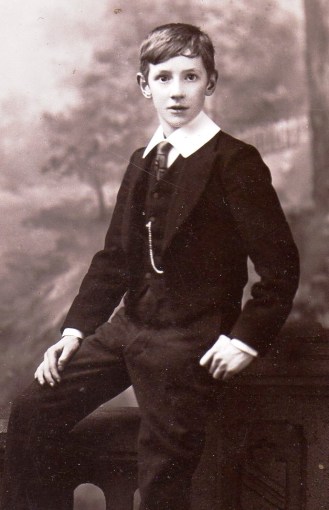
Paine’s father, Charles (1860-1940), was the manager of an India Rubber works though the 1891 census gives his occupation as ‘commercial traveller/manager of rubber works’. According to his third wife (Joan Jefferies née Bolshaw), Charles senior was a strict Methodist and a man with no feeling for art. According to his grandson, Nelson Paine, he was ‘an irascible man who disapproved most strongly at [Paine] becoming an artist’. He expected his son to go into the rubber business. Paine’s uncle showed some of his drawings to Gordon Forsyth, art director of Pilkington’s Tile and Pottery Company at Clifton in Greater Manchester and later Director of the Burslem School of Art, who was favourably impressed. Paine’s uncle went to see his father, presumably to Charles Paine circa 1906/7 persuade him to allow his son to study art, and was ordered out of the house (so the story goes).
At 16 Paine enrolled at the Salford School of Art under Messrs. P. J. J. Brooks and B. D. Taylor, where he was apprenticed to the craft of making stained glass. He also attended evening classes at the Manchester Municipal School of Art under Richard Glazier. The 1911 census records him as an ‘art student’. In 1915 he graduated from Salford to study at the Royal College of Art in London. At the R.C.A. his ability was recognised and he was awarded a National Scholarship, a precursor of a grants scheme. In 1916 Paine was living at 11 North View, Brentham, Ealing W. In that year he first exhibited at the Royal Academy, a design for a stained glass window. I have not been able to find any record of this.
His father did not cut him off entirely and may have contributed to the cost of his training. If he did refuse to pay for his training (uncertain) he certainly helped him financially later on when he got married. (1920) (Eventually he left all his money to a niece, most probably Gwendoline Worthington, who remained unmarried and died at Lytham St. Annes in 1949.) After he left home Paine saw little of his father who died in 1940.
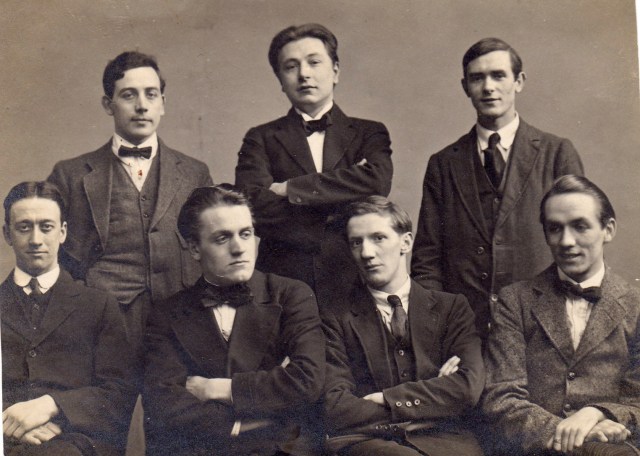
Christmas Social 1916 Royal College of Art
(Paine seated 2nd from right. Others unknown.)
Paine spent a total of six terms at the R.C.A. between October 1915 and 4th July 1919 and graduated with the degree A.R.C.A. His studies were interrupted by the War when in 1917 he was conscripted into the Admiralty Inspection Section. He was said to have learned a lot about gun cotton. One anecdote survives from that time. When the war ended he was in a car going past the famous ‘Cat & Fiddle’ near Buxton, the second highest pub in England, with ‘a dull admiral’. The admiral exclaimed, ‘Hurrah! Hurrah!’ which Paine evidently found very amusing. He never took himself too seriously and was amused by pomposity in others.
On 1st July 1920 Paine married Marian (‘Marie’) Jane Nelson at St. Stephen’s Green Church in Dublin, an Irishwoman aged 30, a fellow student at the R.C.A. The Irish conductor and composer Havelock Nelson (1917-1996) was her nephew. Paine’s mother, Fanny, was a witness. It seems likely that his father did not attend. Nelson Paine said that for Paine’s father his son marrying ‘an Irish girl . . . was the last straw!’ His residence is given as Burwin, Accresfield Road, Pendleton Manchester. They had one child, a son, Charles Nelson Paine, born in 1923. It was not a happy marriage. The story was told that while he was out one Sunday Maria’s sister and her husband came to visit. Paine was painting a portrait and his brother-in-law (cf. post ‘Buoyant Chairs’ December 17, 2017) drew a moustache on it. This, apparently, was the last straw. Paine packed up and left (1928). Marian returned to Ireland in the summer of 1930 with Nelson, then aged 7, and lived at Dunlaogherie. Thereafter Paine had very little connection with his father.
For a fuller account of these events see ‘Marian, Katherine and Anna’ 22 October 2018.
Following his graduation from the R.C.A. in 1919, aged 24, Paine was appointed Head of the Department of Applied Arts at Edinburgh College of Art with the brief of reorganising the department, the beginning of a distinguished career.
Revised 1925
 Charles Paine A.R.C.A.